
Finding a place to live is rarely just about four walls and a roof. For NDIS participants and the families supporting them, the search for good NDIS disability housing is really a search for stability, dignity, and a sense of belonging. It’s a question Mecura thinks about constantly, because the way accommodation is set up and supported shapes almost every other part of a person’s day. Mecura is an NDIS provider built around an evidence-based cognitive support system that connects families, support workers, and clinicians into one coordinated pathway, and much of that coordination starts with getting housing right.
Getting there usually means understanding what ndis disability accommodation actually involves, how funding categories work, and what separates a house that merely functions from one that genuinely feels like home. This article walks through the practical and emotional factors that matter most, drawing on how Mecura approaches accommodation for participants on the Gold Coast and in Perth.
Key Takeaways
Good NDIS disability housing is built on consistency, meaning the same routines, support workers, and communication habits show up day after day rather than changing unpredictably. Visibility matters just as much, since families, support coordinators, and allied health professionals all need to see the same information at the same time to make good decisions together. Housing that works well tends to combine the right physical design, whether that’s Specialist Disability Accommodation (SDA) features or a well-matched Supported Independent Living (SIL) arrangement, with a support team that actually communicates. Mecura’s coordinated model aims to reduce the gaps between these pieces, so participants spend less time managing paperwork and more time living their lives. For people in Helensvale, Oxenford, Surfers Paradise, Joondalup, or Ocean Reef, that also means having a provider nearby who understands local services and can respond quickly when something changes.
What “Home” Really Means in NDIS Disability Housing
More than 5.5 million Australians live with disability, according to the Australian Bureau of Statistics, and a meaningful share of them rely on NDIS-funded housing at some point. A house becomes a home when a person feels safe enough to relax into their own routine. For someone with high support needs or a cognitive impairment, that safety depends on far more than accessible bathrooms or wide doorways. It depends on knowing who is coming through the door each day, whether their support worker has actually read their care plan, and whether small changes in behaviour get noticed before they become a crisis.
Consistency: The Foundation of Comfortable Disability Housing
Staff turnover and inconsistent handovers are among the most common complaints families raise about disability accommodation. When every shift feels like starting from scratch, participants can become anxious and support quality dips. Mecura’s approach leans on structured handovers and shared records, so a support worker walking in on a Tuesday has the same picture of a participant’s needs as the one who was there on Monday.
Visibility: Keeping Everyone on the Same Page
Visibility is the less glamorous cousin of consistency, but it’s just as important. Families often describe feeling shut out of decisions about their loved one’s care simply because information sat in one worker’s notebook or one coordinator’s inbox. A coordinated pathway that gives families, support workers, and professionals visibility into the same notes and goals closes that gap, and it’s one of the clearest ways a provider builds trust over time.
How Mecura’s Coordinated Approach Supports Better NDIS Disability Housing Outcomes
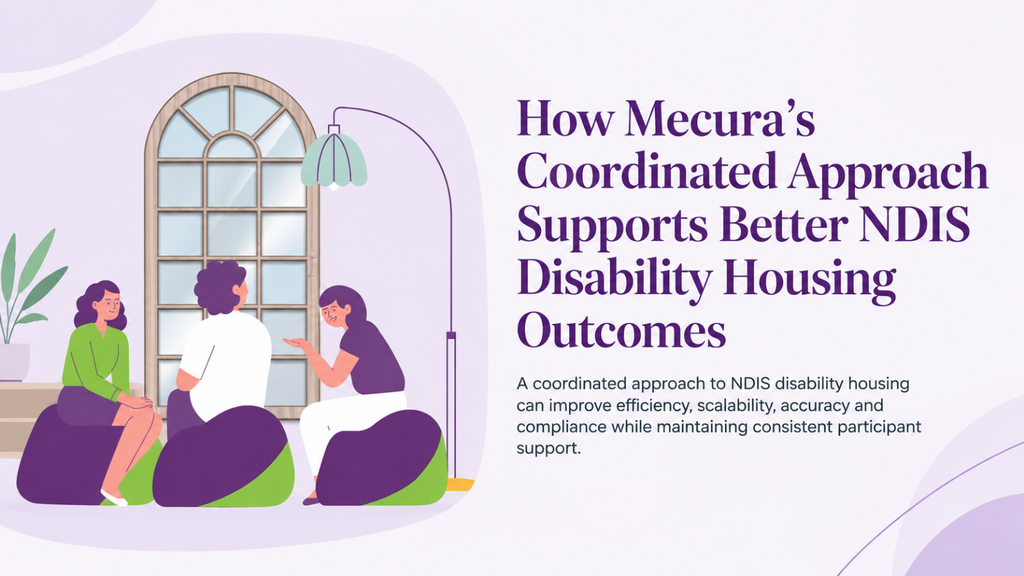
The day-to-day quality of NDIS disability housing depends heavily on the systems working quietly in the background. Below are four areas where a coordinated model, like the one Mecura uses, tends to produce noticeably better results than a fragmented one.
Efficiency and Scalability
When information about a participant lives in one shared system rather than scattered across phone calls and paper files, support teams spend less time chasing updates and more time delivering care. This matters for a single household, but it becomes essential once a provider supports many participants across different homes, as Mecura does across its Gold Coast and Perth properties. A scalable system means growth doesn’t come at the cost of personalised attention.
Accuracy and Compliance
NDIS housing sits inside a framework of registration standards and reporting obligations set out by the NDIS Quality and Safeguards Commission. Accurate, well-maintained records aren’t just an administrative nicety, they’re what keeps a provider compliant and participants protected. A structured, evidence-based system reduces the chance of missed reviews, outdated care plans, or gaps between what’s funded and what’s actually delivered.
Workflow Optimisation for Families and Support Teams
Families juggling appointments, plan reviews, and day-to-day requests often carry an invisible administrative load. Streamlining how referrals and updates move between everyone involved takes some of that weight off. When a family raises a concern, it shouldn’t need five phone calls to reach the right person; a well-designed workflow gets it there in one.
Documentation Outcomes That Hold Up
Clear documentation protects everyone. It gives families a reliable record of what support has been agreed to and delivered, gives support workers clarity about their responsibilities, and gives the provider a defensible paper trail if a dispute or audit arises. It’s one of the quieter reasons Mecura invests in coordinated recordkeeping rather than ad hoc notes.
Choosing between accommodation types is part of this same picture. Reading through the details of ndis disability accommodation options, including how SDA design categories and SIL supports interact, is a useful next step for families comparing what’s actually available to them.
Finding NDIS Disability Housing Near You in Gold Coast and Perth
Local knowledge counts for a lot in disability housing. A provider who understands the pace of the Gold Coast property market, or the layout of Perth’s northern suburbs, can usually move faster when a vacancy comes up or a home needs modifying. Mecura operates properties and support coordination across Helensvale, Oxenford, and Surfers Paradise in Queensland, along with Ocean Reef and the wider Joondalup area in Western Australia, giving participants a genuinely local option rather than a distant call centre.
For families searching for supported living options near you in these regions, it’s worth asking any prospective provider a few direct questions: how often will support workers rotate, who do we contact after hours, and how is information shared between the coordinator, the support team, and us as a family? These questions matter more than they might seem. People with disability are more than twice as likely to live alone as those without, according to the Australian Institute of Health and Welfare, which makes reliable, well-coordinated local support a genuine safeguard rather than a nice-to-have. The answers usually reveal more about day-to-day quality of life than a glossy brochure ever could.
Cognitive Support and Everyday Independence
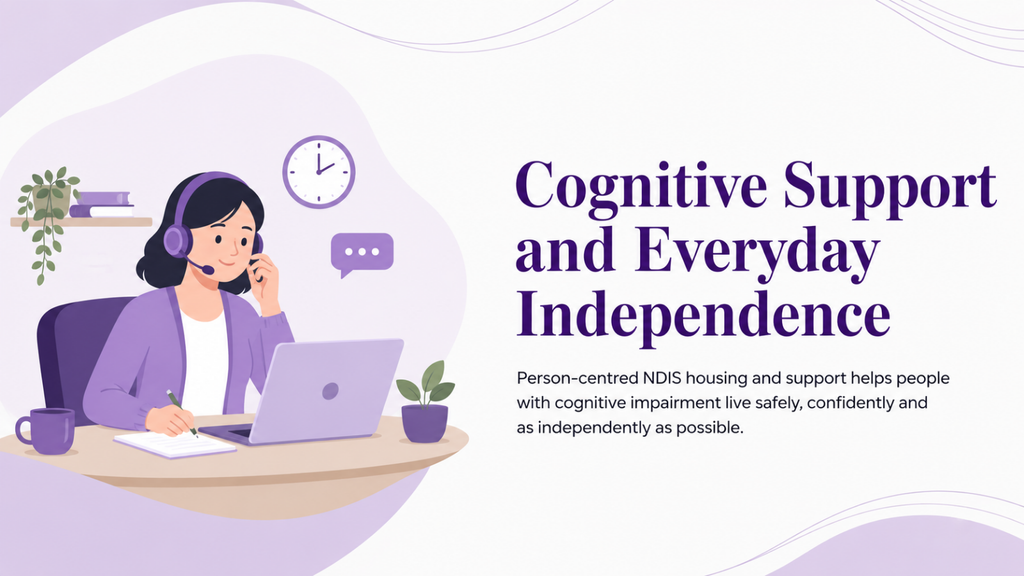
A meaningful share of NDIS participants live with some form of cognitive impairment, whether that’s related to acquired brain injury, early-onset dementia, or a lifelong intellectual disability. Cognitive impairment can affect memory, decision-making, and daily routines in ways that aren’t always visible from the outside, which is exactly why housing and support need to be built around the person rather than a one-size-fits-all model.
Understanding cognitive impairment examples helps families and support workers recognise early warning signs and adjust support before small issues grow into bigger ones. Similarly, learning about mild cognitive impairment can help households plan ahead, particularly when a participant’s needs are likely to change gradually over time. Mecura’s broader approach, outlined on its Cognitive Support page, treats this kind of early observation as part of good housing support, not a separate service bolted on afterwards.
Frequently Asked Questions
What are the eligibility criteria for Specialist Disability Accommodation (SDA)? SDA is intended for participants with extreme functional impairment or very high support needs, where standard housing wouldn’t adequately meet those needs. Eligibility is assessed by the NDIS based on functional capacity, and funding is included in a participant’s plan rather than applied for separately.
How do SDA and SIL housing options compare for NDIS participants? SDA funds the physical dwelling, things like accessible design or ceiling hoists, while Supported Independent Living (SIL) funds the personal care and support workers who help inside that home. Many participants use both together: SDA provides the house, SIL provides the people supporting them in it.
What NDIS funding is available for housing support? Housing-related funding can appear across several categories, including SDA for eligible participants, SIL for daily living support, and Capital Supports for home modifications or assistive technology. The right mix depends on individual needs, so it’s worth discussing options with a support coordinator during a plan review.
What are the best NDIS disability housing providers in Australia? The right provider depends on location, the participant’s support needs, and how well their communication style matches what the family wants. Look for a registered NDIS provider with transparent processes, consistent staffing, and a track record of coordinating well with families and allied health professionals.
What services do NDIS disability housing providers typically include? Most providers combine accommodation with support coordination, personal care through SIL where relevant, regular reviews, and communication with families and clinicians. Some, like Mecura, also build structured cognitive monitoring into that support.
Where can I find NDIS-approved disability housing listings? The NDIS SDA Finder is the main national tool for browsing registered vacancies. It’s also worth speaking directly with local registered providers, since not every vacancy is listed publicly at every moment.
Can I get help with home modifications through NDIS disability housing services? Yes. Home modifications are typically funded under the Capital Supports category, covering changes like ramps, bathroom modifications, or door widening. An occupational therapist assessment is usually required before funding is approved.
Conclusion
NDIS disability housing works best when it’s treated as more than a physical space, it’s a system of consistency, visibility, and coordinated support that lets participants actually settle in and live their lives. Getting the accommodation type right, whether that’s SDA, SIL, or a combination of both, matters, but so does having a provider who keeps families, support workers, and professionals genuinely connected day to day. Mecura has built its model around exactly that kind of coordination for participants across the Gold Coast and Perth. If you’d like to see how it works in practice, exploring ndis disability accommodation options with Mecura is a straightforward place to start, or you can reach out directly to talk through what your family currently needs.